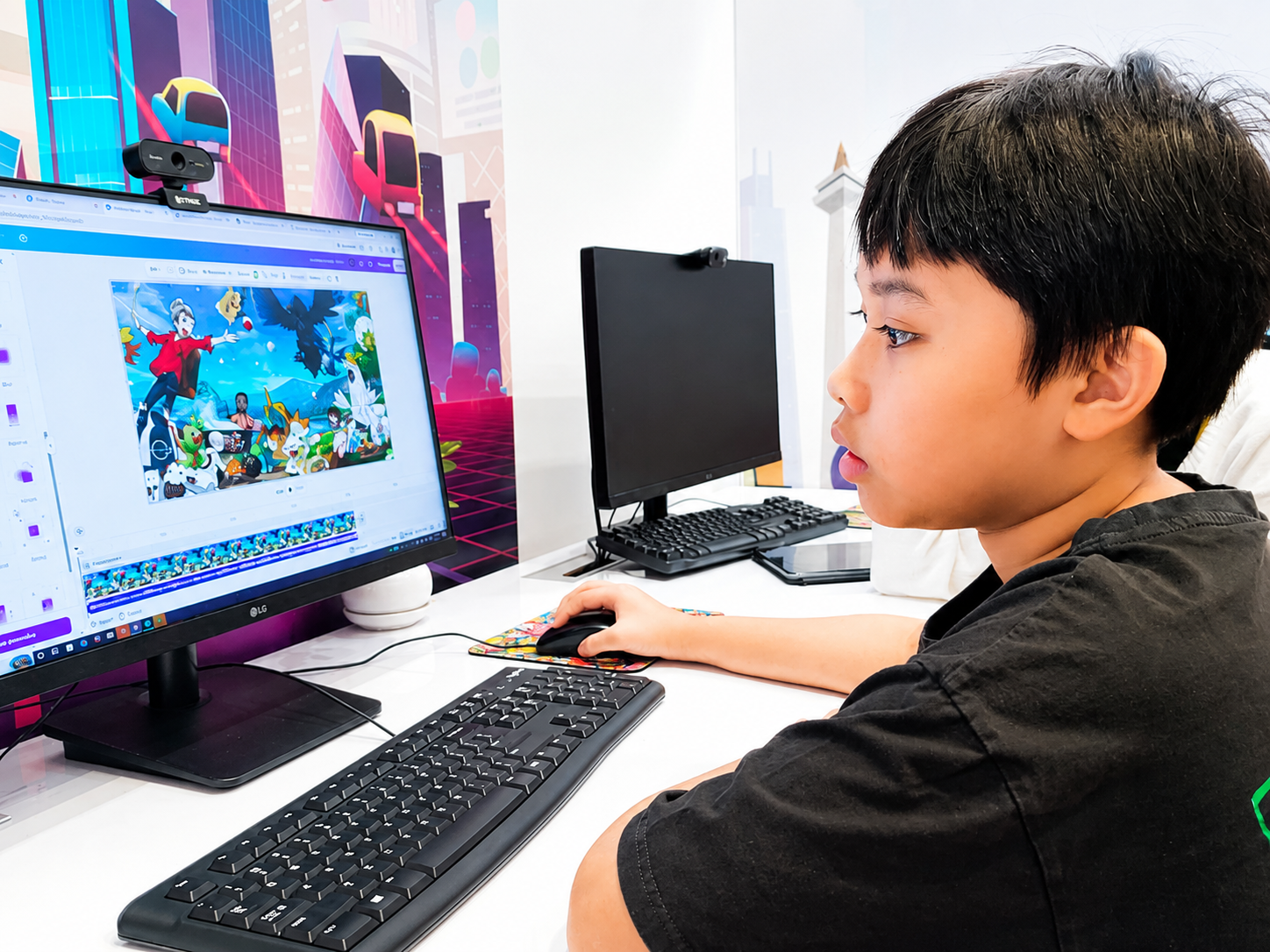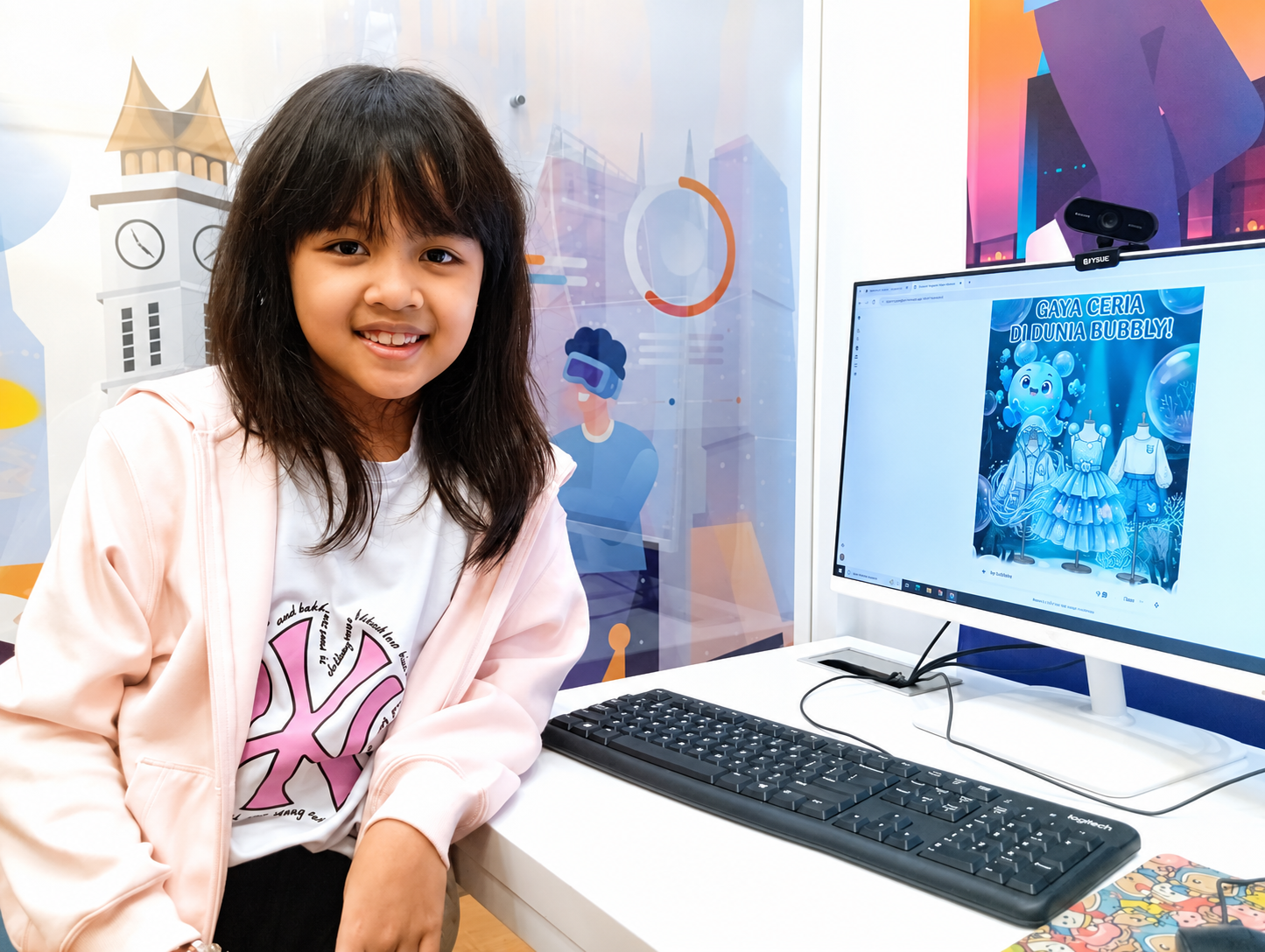
There’s a certain type of child who just can’t stop building. From neatly stacked Lego blocks, to airplane designs sketched in a notebook, to virtual houses built for hours in Minecraft. Parents often wonder: where can energy and imagination like this actually lead?
The answer is becoming clearer: into the 3D modeling industry — one of the digital professions experiencing explosive demand across nearly every sector in the world.
The global AR/VR market, which relies on 3D assets, is projected to jump from $59.75 billion in 2024 to $200.87 billion in 2030. Gaming, film, architecture, healthcare, manufacturing, and e-commerce all need the same thing: three-dimensional objects, characters, and worlds crafted by a skilled 3D artist’s hands. And Indonesia, with the strength of its creative human resources, is in a highly strategic position to help meet that demand.
KEY NUMBERS: GLOBAL 3D MARKET & RELATED INDUSTRIES
$200.87B — Projected global AR/VR market by 2030, up from $59.75B in 2024 (22% average annual growth)
$6.33B — Projected global 3D Model market by 2028 (JayJay.co / Mordor Intelligence)
Rp 4–30M — Salary range for 3D Artists in Indonesia, from junior to senior level (Purwadhika/Indeed 2025)
PART 1: WHY 3D MODELING ISN’T JUST FOR GAMERS
One Skill, Thousands of Industries That Need It
When most people hear “3D modeling,” they immediately picture games or animated films. But that’s really just the tip of the iceberg.
A skilled 3D artist today can work for a game studio in Jakarta, design product prototypes for a manufacturing company in Surabaya, create apartment visualizations for a property developer in Bali, join an animation production pipeline for Netflix, or sell digital assets on global marketplaces like TurboSquid and CGTrader — all from the comfort of home.
In Indonesia, a growing creative industry is generating real demand. Indonesia’s animation industry is still in its early stages, with enormous room to grow. Indonesia is also increasingly viewed by other Asian countries as a service provider, thanks to its strong creative human resources. And the entire production pipeline starts from one point: the 3D model.
“Demand for 3D Artists will keep growing as the entertainment, film, gaming, and advertising industries increasingly rely on three-dimensional visualization. What sets people apart is the combination of technical skill and strong artistic understanding.” — Skilvul, “3D Animator Career Opportunities”
PART 2: 5 IN-DEMAND 3D MODELING SPECIALIZATIONS
From Games to Buildings: 3D Artist Careers Across Industries
3D modeling isn’t a single profession — it’s a large family of specializations, each with its own market and career path.
SPECIALIZATION 1: 3D Character Artist
Creates characters that feel alive, down to the face and the folds of their clothing. Character artists are the ones behind your child’s favorite game heroes, animated film characters, and virtual platform avatars. This path can lead to game studios, film, animation, and even NFTs and the metaverse, using tools like Blender, ZBrush, Substance Painter, and Maya. Remote work from Indonesia for overseas companies is very much possible.
Skills: Blender/ZBrush, Anatomy & Proportion, Texturing, Basic Rigging
SPECIALIZATION 2: Architectural Visualization Artist
Nearly every building, house, or property development offered to prospective buyers today passes through the hands of an architectural visualization artist before the foundation is even laid. They create 3D renders so realistic that clients can “walk through” a building that hasn’t been built yet. In Indonesia’s rapidly growing property and infrastructure sectors, demand for this profession is very consistent.
Skills: 3ds Max/SketchUp/Blender, Lumion/Enscape/D5 Render, Lighting & Materials, Visual Composition
SPECIALIZATION 3: Product & Industrial Designer (3D)
From Nike shoe designs to factory machine components, every physical product today is born from a 3D model before it’s manufactured or printed. With the growth of 3D printing in Indonesia, this profession is becoming even more relevant. Designers who can create production-ready 3D models become the bridge between an idea and physical reality.
Skills: SolidWorks/Fusion 360/Blender, 3D Printing, Product Design, Material Knowledge
SPECIALIZATION 4: Game Environment Artist
The world inside a game doesn’t just appear out of nowhere. There are artists who build every building, tree, road, and sky that a player sees. Indonesia is one of the largest mobile gaming markets in Asia, and local game studios are continuously growing and need this talent. Environment artists who understand game engines like Unity or Unreal Engine hold very high market value.
Skills: Blender/Maya, Unity/Unreal Engine, Texturing & UV Mapping, Basic Level Design
SPECIALIZATION 5: AR/VR 3D Asset Creator
The newest and fastest-growing profession. Asia-Pacific is the fastest-growing market in the AR/VR sector, with a projected CAGR of 35.1% through 2030. The region’s XR market is expected to grow from $28.46 billion in 2024 to $238.37 billion in 2032. All of these virtual worlds need 3D assets optimized for real-time rendering. This is a new frontier for 3D artists willing to move early.
Skills: Blender/Maya, Real-time Optimization, Unity/Unreal Engine, AR Foundation
PART 3: BUILDING THE FOUNDATION EARLY
Blender Is Free. Imagination Can’t Be Bought.
One thing that sets 3D modeling apart from many other digital professions is its remarkably low barrier to entry in terms of tools. Blender is a powerful, versatile, and free 3D software. It’s widely used in the industry for modeling, texturing, rigging, and animation, making it ideal for beginners and professionals alike. That means your child can start learning today without any software investment.
What can’t be bought for free is the thinking foundation that needs to be developed early:
✓ Spatial and Three-Dimensional Thinking The ability to imagine how an object looks from different angles, how light falls on its surface, and how different parts connect. This is a mental muscle that can be trained long before a child ever touches a computer.
✓ Understanding of Proportion and Aesthetics 3D modeling is a fusion of technology and art. A child who understands proportion, composition, and visual design principles will create work that’s both technically correct and visually pleasing.
✓ Patience and Attention to Detail Professional 3D models are built vertex by vertex, polygon by polygon. This profession rewards those who can work carefully and patiently over long periods — a trait that’s much easier to instill at a young age.
✓ Problem Solving and Technical Thinking Every 3D model is a series of decisions: what geometry is most efficient, how to keep UV mapping clean, how to optimize polygon count for games. Systematic thinking and technical problem-solving are core skills.
✓ Consistent Practice and Portfolio Building In the 3D industry, a CV doesn’t speak — a portfolio does. A child who starts building work early will have a strong portfolio long before entering the workforce.
What Age Should They Start?
AGES 6–8: Thinking in 3D Through the Real World Build with Lego, Magna-Tiles, or clay. Play Minecraft to construct structures with spatial logic. The goal isn’t software — it’s training spatial intuition and three-dimensional imagination.
AGES 9–11: First Introduction to Digital 3D Start exploring TinkerCAD (free, browser-based, designed for beginners). Create simple objects: a chair, a house, an imaginary vehicle. Print with a 3D printer if available, to see digital work become real.
AGES 12–14: Moving Into Blender Blender can be introduced at this age with structured guidance. Focus on basic modeling, understanding the interface, and creating simple objects through to a first character. YouTube tutorials and the Blender community are rich resources for this age group.
AGES 15–18: Specialization and Portfolio Decide on a direction: character, environment, product, or architecture. Learn proper texturing and rendering. Start posting work to ArtStation or Sketchfab to build a digital reputation early.
FAQ: PARENT QUESTIONS
Can 3D modeling really be a career that supports someone financially?
In Jakarta, 3D artist salaries range from Rp 4–8 million per month for juniors, Rp 8–15 million for mid-level, and Rp 15–30 million or more for seniors. This doesn’t even include potential freelance income from global marketplaces, where Indonesian 3D artists can sell assets in US dollars.
Does my child need to know how to draw before learning 3D modeling?
Not required, but very helpful. An understanding of proportion, perspective, and aesthetics — usually developed through drawing — will speed up development as a 3D artist. But many professional 3D modelers weren’t strong illustrators to begin with; they developed their skills through practice within the software itself.
Isn’t 3D software expensive?
Blender, the industry-standard software used by professional studios worldwide, is completely free and open source. TinkerCAD for beginners is also free and browser-based. The cost barrier to starting 3D modeling today is very low.
What’s the difference between 3D modeling and animation?
3D modeling is the process of creating a three-dimensional object or character. Animation is the process of making it move. Both are often done by the same person at small studios, but at larger studios these are two separate departments. Many 3D modelers never work on animation at all — for example, those focused on architectural visualization or product design.
A child who enjoys building, designing, and turning ideas into real, tangible forms has one of the most valuable assets in this industry: three-dimensional imagination that can’t be taught from a textbook. Our job is to give them the tools and the space to develop it.